Bend App Review 2026: Is This Stretching and Flexibility App Worth It?
Bend is a stretching, mobility, and light exercise platform built around short guided routines. Instead of offering long yoga classes, it focuses on simple daily sessions for areas such as the hips, hamstrings, shoulders, neck, posture, and lower back.
But is the Bend stretching app actually useful? Is the Bend app free, how much does premium access cost, and is it suitable for complete beginners?
In this detailed Bend app review, we examine its routines, customization tools, user feedback, pricing, strengths, limitations, and whether the Bend stretching and flexibility app is worth trying in 2026.

📱 What Is the Bend App?
Bend is a stretching, flexibility, mobility, yoga, and isometric exercise app developed by Bend Health & Fitness.
The app offers hundreds of stretches and yoga poses, along with guided routines designed for different body areas, experience levels, and daily needs. Its store listings describe Bend as a quick and convenient way to make stretching part of an everyday routine.
At the time of writing:
- Google Play shows more than 5 million downloads
- The Android version has a rating of approximately 4.7 stars
- Google Play displays roughly 158,000 reviews
- The US App Store shows approximately 4.8 stars
- The App Store displays around 172,000 ratings
The app can be downloaded for free, but it includes in-app purchases and paid memberships.
Bend at a Glance
| Category | Details |
|---|---|
| App type | Stretching, flexibility, mobility and light exercise |
| Developer | Bend Health & Fitness |
| Platforms | Android, iPhone, iPad and Apple Watch |
| Free download | Yes |
| In-app purchases | Yes |
| Custom routines | Available |
| Guided timers | Available |
| Progress tracking | Available |
| Daily reminders | Available |
| Yoga poses | Included |
| Isometric routines | Included |
| Beginner-friendly | Generally yes |
🧘 How Does the Bend Stretching App Work?
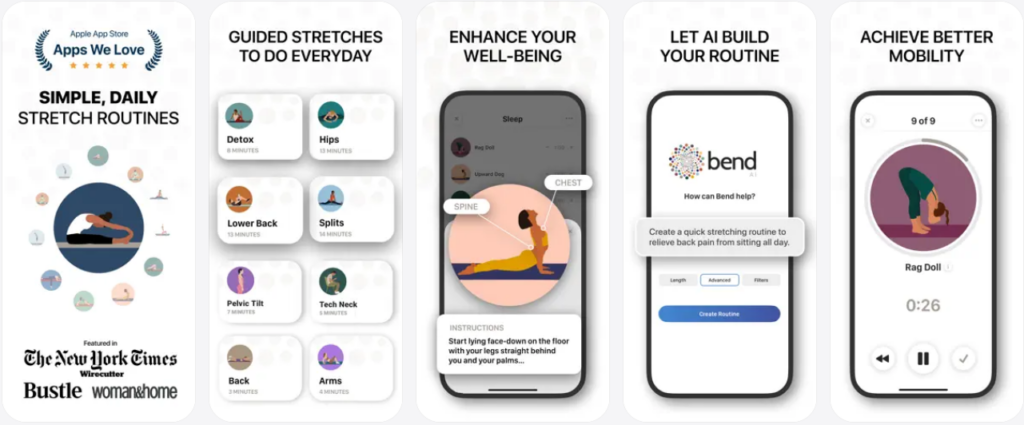
Bend allows users to choose a pre-made routine or create a custom stretching session.
A typical Bend session may include:
- A visual illustration of each stretch
- Written instructions
- A timed hold
- A short transition period
- An audio or visual signal when it is time to switch sides
- Progress and streak tracking after completion
Users can choose routines based on a goal, body area, or time of day.
Instead of following a continuous instructor-led class, the app presents stretches individually and moves through them using timers and custom illustrations. Each stretch also includes information about its purpose and precautions.
This format may suit people who want something simpler than a full yoga video.
However, users who prefer detailed voice coaching or flowing transitions may find the experience less immersive than a traditional yoga app.
✨ Main Features of the Bend App
🌅 Wake Up Routine
The Wake Up routine is designed as a short daily mobility session.
It may include gentle movements intended to help users:
- Move after sleeping
- Reduce morning stiffness
- Prepare for the day
- Maintain everyday mobility
- Build a consistent stretching habit
Bend promotes this routine as a simple option that can be completed regularly without requiring a large amount of time.
🪑 Posture Reset
Posture Reset includes seated and standing stretches focused on the:
- Shoulders
- Upper back
- Neck
- Chest
- Spine
This routine may appeal to users who:
- Work at a desk
- Spend long periods using a computer
- Sit for much of the day
- Feel tightness around the shoulders
- Want short movement breaks
The app describes Posture Reset as a routine designed to address common posture-related tightness by improving flexibility around the shoulders, back, and neck.
It should not be treated as a medical solution for persistent pain or structural posture problems.
🤸 Full Body Stretching
The Full Body routine contains more than 20 stretches and poses targeting major muscles and joints throughout the body.
It may include movements for:
- Hamstrings
- Hips
- Back
- Shoulders
- Chest
- Legs
- Ankles
- Neck
This option may be useful after a workout, on a recovery day, or when users want a longer general mobility session.
🌙 Sleep Routine
The Sleep routine uses slower, longer-hold stretches intended to help users unwind.
It may be suitable for:
- Evening mobility
- Relaxing before bed
- Releasing general muscle tension
- Creating a calming nightly habit
Bend markets this routine as a way to combine stretching with an evening relaxation ritual.
The app cannot guarantee improved sleep, but some users may find gentle movement calming.
🔥 Expert Routine
Bend also includes more advanced stretches and yoga poses for users with greater flexibility or movement experience.
The Expert routine may contain:
- Deeper stretches
- More demanding mobility positions
- Advanced yoga-inspired poses
- Full-body flexibility work
Users should progress carefully. A routine being labelled “advanced” does not mean it is appropriate for every experienced exerciser.
🦵 Hips and Hamstrings
The app offers targeted routines for tight hips and hamstrings.
These may appeal to people who:
- Sit for long periods
- Run or cycle
- Feel stiff after strength training
- Want to improve their range of motion
- Are working toward flexibility goals
Bend’s descriptions say its hip and hamstring routines are designed to address tightness and improve mobility around the pelvis, knees, and lower body.
Users with pain should distinguish between ordinary tightness and an injury that needs professional evaluation.
🧍 Lower Back Routine
The lower-back routine includes gentle stretches targeting areas such as:
- Lower back
- Hips
- Pelvis
- Hip flexors
Bend promotes this routine for flexibility and relief from general stiffness.
Some reviewers report personal improvements in lower-back tightness, but those experiences should not be treated as medical evidence.
💪 Isometric Exercise
Bend also offers isometric routines.
Isometric exercises involve holding a muscle contraction without repeatedly moving through a full range of motion.
These sessions may focus on:
- Strength
- Stability
- Balance
- Range of motion
- Muscle control
The app includes isometric exercises alongside stretching and yoga poses, giving it a broader scope than a basic flexibility timer.
🛠 Custom Stretching Routines
One of Bend’s strongest features is the ability to create custom routines.
Users can choose:
- Which stretches to include
- The target body areas
- How long to hold movements
- The order of exercises
- The overall purpose of the session
The app provides access to hundreds of stretches, yoga poses, and isometric exercises for building these custom sessions.
This may be particularly useful for:
- Desk-break routines
- Sport-specific stretching
- Post-workout mobility
- Morning movement
- Targeting recurring areas of stiffness
⏱ Timers and Illustrated Guidance
Bend uses custom illustrations rather than long instructor videos.
Each movement includes:
- A visual demonstration
- Written instructions
- A timer
- Guidance on benefits
- Caution information
This design keeps the app clean and easy to navigate.
However, it may not offer enough coaching for users who need detailed explanations of how to move between poses.
🔔 Reminders, Streaks and Analytics
The app includes:
- Daily reminders
- Stretching streaks
- Completion statistics
- Activity analytics
- A consistency indicator called the Bendometer
These features are intended to encourage regular practice and help users monitor how often they stretch.
Streaks may motivate some people, but they can also feel discouraging when one missed day resets progress.
💬 Bend App Reviews: What Are Users Saying?
Overall feedback is strongly positive on both major app stores.
Users commonly praise:
- Short sessions
- A clean interface
- Easy-to-follow instructions
- Custom routines
- Timers and transition signals
- Targeted stretching plans
- Daily reminders
- Streak motivation
- Flexibility improvements
The main criticisms involve repetition, limited transition time, lack of detailed audio coaching, and some routines feeling too difficult for beginners.
⭐ Positive Bend App Reviews
Positive reviewers often say that Bend helps them stretch more regularly.
Common strengths mentioned include:
- The sessions are short enough for work breaks
- Visual and written instructions are easy to understand
- Custom routines are practical
- Pre-made sessions target useful areas
- Timers remove the need to watch the clock
- Streaks encourage consistency
One Google Play reviewer said the app’s short routines and clear instructions made it useful for relieving shoulder tension during work breaks. Another praised the Wake Up, Full Body, Posture Reset, and Sleep routines, along with the statistics and reminders.
A more recent Android reviewer described the design as simple and appreciated being able to create stretching sessions for desk-based study breaks.
These are individual user experiences rather than guaranteed results.
⚖️ Mixed Bend App Reviews
Some users enjoy the app but believe it needs additional features.
Mixed feedback includes:
- Routines can become repetitive
- More mobility movements would improve variety
- Skipping an exercise may not provide enough setup time
- Transition periods can feel too short
- Streaks can feel overly strict
- Beginners may need easier alternatives
- Dark mode and more flexibility goals would be useful
One App Store reviewer said the app remained useful but felt repetitive after extended use and requested a wider exercise library. Another wanted more flexible goal tracking instead of an all-or-nothing daily streak.
❌ Bend App Complaints
The most important criticism involves guidance for beginners.
Potential complaints include:
- Limited verbal coaching
- Very short transitions between positions
- No live posture correction
- Some beginner movements still require considerable flexibility
- Instructions may require pausing the timer to read
- Routines may not feel truly personalized
- Full access requires payment
One App Store reviewer said the five-second transitions felt too short and argued that beginners needed more visual and spoken guidance when moving between stretches.
This suggests that Bend may work best for users who are already somewhat comfortable interpreting stretching illustrations.
⚖️ Bend Review Summary
| Area | General Feedback |
|---|---|
| Ease of use | Strong |
| Routine length | Short and convenient |
| Customization | Strong |
| Visual instructions | Clear |
| Voice guidance | Limited |
| Stretching variety | Good, but some users want more |
| Beginner accessibility | Generally good, with limitations |
| Progress tracking | Useful |
| Streak system | Motivating for some |
| Subscription value | Better for regular users |
| Overall app ratings | Strong |
🌱 Is the Bend Exercise App Good for Beginners?
Bend can be suitable for beginners because it includes:
- Simple illustrations
- Written instructions
- Timed stretches
- Short routines
- Beginner selections
- Precaution information
- Targeted sessions
However, beginners may still encounter limitations.
Some user reviews report that:
- Transitions are too fast
- Certain stretches require more mobility than expected
- Modifications are not always clear
- More detailed audio coaching would help
Complete beginners should pause when necessary and avoid treating the timer as a requirement to rush into position.
🆓 Is the Bend App Free?
The Bend app is free to download, but full access is not permanently free.
Users may be able to:
- Install the app
- Explore selected content
- View certain routines
- Test the interface
Premium access is required for the broader library and complete experience.
The exact free content can vary by platform, region, account, and promotion.
💰 Bend App Cost: How Much Does It Cost?
The Bend app cost varies depending on the plan, promotion, platform, and country.
The US App Store currently lists several example purchase options, including:
- Monthly membership options around $4.99
- Other monthly options listed at $9.99 or $13.99
- Discounted annual plans ranging from approximately $19.99 to $39.99
Example Bend App Price Range
| Plan Type | Example US App Store Price |
|---|---|
| Monthly membership | Around $4.99–$13.99 |
| Discounted annual plan | Around $19.99–$39.99 |
| Promotional discounts | May vary |
Not every user will see every price.
Some listed options may represent:
- Introductory offers
- Older plans
- Account-specific promotions
- Limited-time discounts
- Different membership packages
The final checkout screen should always be treated as the most accurate price source.
🔁 How Does the Bend Subscription Work?
A paid Bend membership may unlock:
- More pre-made routines
- The full movement library
- Custom routine tools
- Expanded stretching programs
- Progress and analytics features
- A more complete experience
Subscriptions may renew automatically unless canceled before the renewal deadline.
🆓 Bend Free vs Paid Version
| Feature | Free Version | Paid Version |
|---|---|---|
| App download | Yes | Yes |
| Limited routines | Available | Expanded |
| Full stretch library | Limited | Available |
| Custom routines | May be restricted | Available |
| Targeted programs | Limited | Expanded |
| Analytics | Basic or limited | Expanded |
| Daily reminders | Available or limited | Available |
| Complete long-term access | No | Active while subscribed |
The free version may be enough to understand the app’s style.
Users who plan to stretch frequently and use custom sessions may get more value from the paid version.
✅ Pros and Cons of the Bend App
Pros
- Short stretching routines
- Clean and simple interface
- Hundreds of stretches and yoga poses
- Custom routine creation
- Targeted sessions for hips, hamstrings, posture, and lower back
- Wake Up and Sleep routines
- Full Body program
- Isometric exercises
- Illustrated instructions
- Built-in timers
- Reminders and streaks
- Progress analytics
- Apple Health integration
- Strong app-store ratings
- Suitable for home and work breaks
- No large equipment required
Cons
- Complete access requires payment
- Limited spoken guidance
- Transitions may feel too short
- Some routines can become repetitive
- Beginner modifications may be limited
- No live form correction
- Streaks may feel overly strict
- Deeper yoga instruction is limited
- Pricing varies widely between offers
- Not a substitute for physiotherapy
- Some movements may be unsuitable for injuries
🔥 Top 5 Yoga Apps Right Now 🔥
We’ve ranked the top 5 apps of 2026.